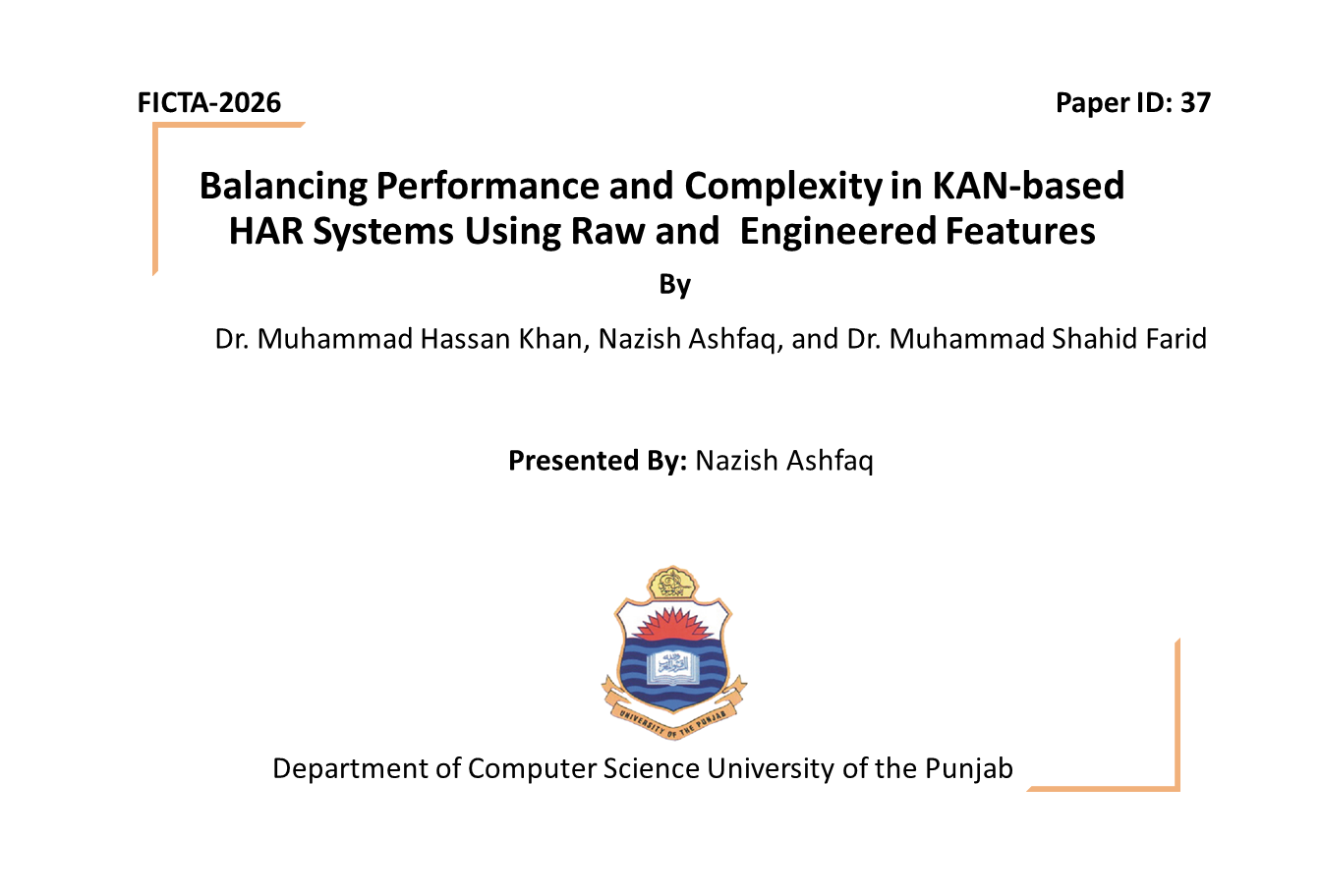
London, United Kingdom — Nazish Ashfaq presented the conference paper titled
“Balancing Performance and Complexity in KAN-based HAR Systems Using Raw and Engineered Features”
at FICTA-2026, held at Holiday Inn, London, United Kingdom,
during 08–09 June 2026. The paper was assigned
Paper ID: 37 and was authored by
Dr. Muhammad Hassan Khan, Nazish Ashfaq, and Dr. Muhammad Shahid Farid
from the Department of Computer Science, University of the Punjab, Lahore, Pakistan.
The research focuses on Human Activity Recognition (HAR) using wearable sensor data
and investigates how different input representations influence the performance of
Kolmogorov-Arnold Network-based architectures.
The study compares two KAN-based architectures:
Multi-Branch Kolmogorov-Arnold Network (MBKAN) and
Multi-Branch Temporal Kolmogorov-Arnold Network (MBTKAN).
The models were evaluated on two benchmark Human Activity Recognition datasets:
UCI-HAR and WISDM.
The work particularly examines two data paradigms: raw sensor signals and handcrafted
feature-based representations. The findings show that MBTKAN performs more effectively
on raw sensor data because of its ability to capture temporal dependencies, while MBKAN
achieves superior performance on handcrafted features due to its lower complexity and
efficient nonlinear representation learning.
Experimental results demonstrated that MBTKAN achieved strong performance on raw sensor
data, particularly on the WISDM dataset, where temporal modeling played a key role in
recognizing activity patterns. In contrast, MBKAN achieved the best results on handcrafted
features, obtaining 96.40% accuracy on WISDM and 95.83% accuracy on UCI-HAR.
These results highlight an important research insight: increasing architectural complexity
does not always guarantee improved performance. Instead, the effectiveness of a model
strongly depends on the nature of the input representation.

This presentation at FICTA-2026 emphasized the need to balance model performance,
computational complexity, and data representation in practical HAR systems. The study
contributes to the growing research area of interpretable and efficient deep learning
models for wearable sensor-based activity recognition.
The main conclusion of the work is that MBTKAN is more suitable for raw temporal
sensor signals, whereas MBKAN is more effective and computationally
efficient when informative handcrafted features are available.